Topicals, oral antifungals, hot laser and cold laser compared on efficacy, safety, ease of use and patient compliance — so you can justify what you recommend.
Fungal nail infection accounts for roughly half of all nail abnormalities seen in adults, and it remains one of the most frustrating presentations in podiatry. Some clinics reach for topical creams and lacquers, some refer back to the GP for oral medication, and a growing number now offer laser — hot or cold — in their own rooms. With more options on the table, it helps to compare them on the four things that actually decide the outcome: efficacy, safety, ease of use and compliance.
Topical creams, lacquers and paints
Topicals are applied to the nail surface, most commonly amorolfine, morpholine or ciclopirox in Australia. The nail's own anatomy works against them: reported drug concentration falls by around a thousandfold between the outer and inner nail, so a large share of the fungal load is never reached.
- Efficacy: roughly 5.5–17.8% on their own, rising toward 38% when combined with regular podiatric debridement.
- Safety: generally mild and local — irritation, redness, scaling, itching, nail discolouration; most products are not indicated under 18.
- Ease of use: needs daily self-application to the toes, which is hard for patients with limited reach, unsteady hands or poor vision.
- Compliance: nine to twelve months of daily use is a big ask when fewer than one in three patients can expect a full cure.
Oral antifungals
Terbinafine and itraconazole bypass the nail barrier entirely, and both have good-quality evidence against placebo. The catch is the gap between endpoints: mycological cure (a negative culture and KOH test) is reported as high as 54–70% at 48 weeks, while complete cure — a fully clear nail — sits closer to 14–38% in the same reviews. Up to a fifth of patients relapse within months of finishing.
- Safety: hepatotoxicity and taste disturbance with terbinafine; itraconazole interacts with warfarin and oral hypoglycaemics, both common in podiatric caseloads.
- Ease of use: high — a daily tablet alongside existing medication.
- Compliance: measured at only about 55% in a 330-patient study, driven mainly by fear of side effects, assuming the infection was already cured, and cost.
Laser: hot versus cold
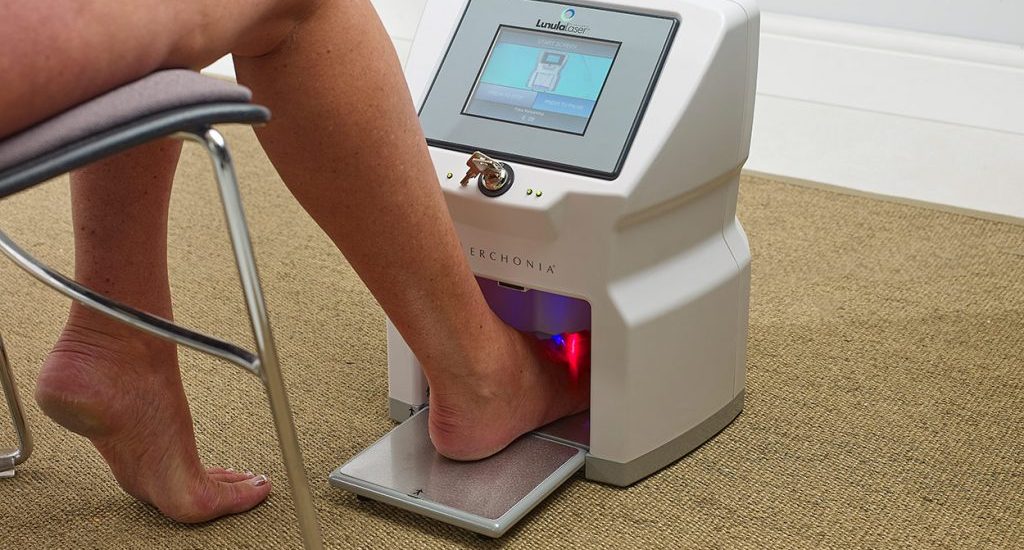
Hot laser heats the nail to around 50 °C to inhibit and destroy the fungus, and the heat is the mechanism rather than a side effect. Cold laser works differently: the Lunula delivers two rotating low-level beams at once — one acting on fungus in the nail, nail bed and surrounding tissue, the other supporting the body's own immune response to clear it.
up to 85%
clearance reported for hot laser in smaller studies
up to 99%
clearance reported for cold laser
4 of 323
cold-laser patients with recurrence at 48 weeks
Against a background relapse rate for onychomycosis reported between 40% and 70%, those recurrence figures are notable, and laser efficacy has been shown across mild, moderate and severe infections.
- Safety: cold laser is non-invasive with no temperature change and no reported adverse effects; hot laser can cause pain and occasional post-treatment bleeding, sometimes managed with air cooling.
- Ease of use: hot laser is hand-held and worked toe by toe; the Lunula is automated, treating all five toes in a 12-minute session once the practitioner has assessed and positioned the foot.
- Compliance: both are in-clinic protocols, so adherence depends on attendance rather than daily patient effort — a short course of appointments instead of a year of self-application.
What this means for your clinic
On the evidence, the weakest link in topical and oral therapy is rarely the drug — it is the delivery and the year-long demand placed on the patient. An automated, non-thermal in-clinic protocol removes both problems, and the unattended treatment window is time you can spend on infection-control and home-care education, which is what actually prevents reinfection.
Figures quoted here are drawn from published literature and manufacturer information; individual patient outcomes vary.
References & further reading
- 1.Abrahams C. Lasers and onychomycosis — Podiatry Management, October 2019 (PDF)
- 2.Zang K et al. A retrospective study of non-thermal laser therapy for the treatment of toenail onychomycosis — J Clin Aesthet Dermatol, 2017 (PMC5479474)
- 3.Zang K. Treatment of toenail onychomycosis using laser pharmacology — Int J Dermatol Clin Res, 2021
- 4.Erchonia Lunula — toenail onychomycosis clinical study results report (FDA submission, DOCX)
- 5.Sullivan R. Erchonia laser therapy in the treatment of onychomycosis: preliminary report — Podiatry Review, Vol 71(2), 2014 (PDF)
Considering the Lunula for your clinic?
We can walk you through the protocol, the evidence and the numbers for your practice.
Talk to usMore articles
Clinical practice
Patients not getting results from standard antifungal nail treatments — what next?
Competitive research
Top nail fungus innovations: which one earns a place in your clinic?
Clinic business
Lunula laser ROI: is it worth the investment for your clinic?
Clinic business
Unsure if Lunula is right for you? Trial it with us
Innovation
Onychomycosis: past, present and future with Glynis Ablon, MD, FAAD
Clinic business
Your Lunula laser marketing strategy: filling the appointment book